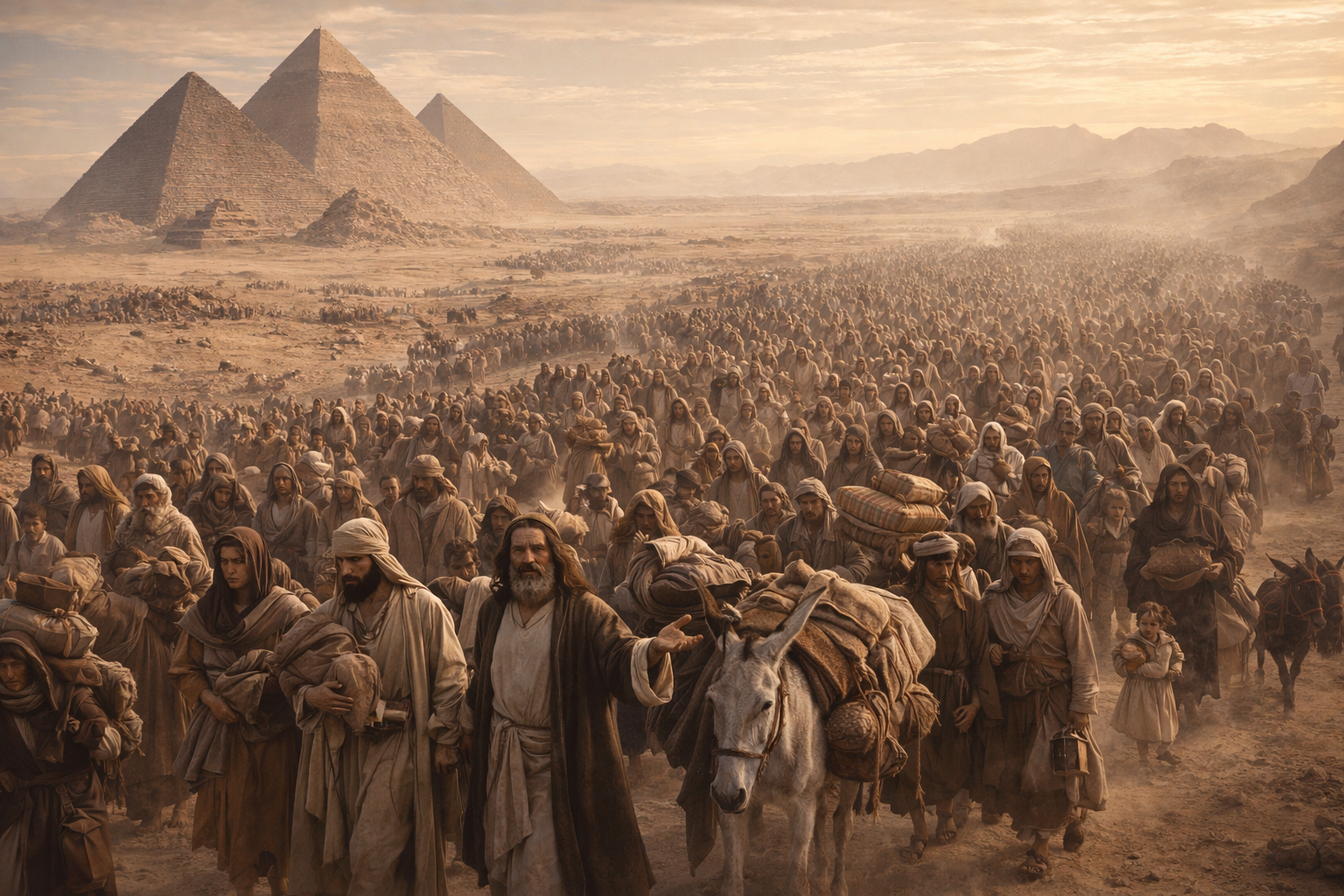
When one thinks of redemption, one thinks of Pesach. There are many statements relating to geulah that are connected to Nissan and Pesach. However, there are also many sources relating to geulah in general. What are these sources, and how can they all be understood together?
The Nissan Factor
We just celebrated Rosh Chodesh Nissan, which reminds us of the Gemara (Rosh Hashanah 11a). Rabbi Yehoshua (ben Hananiah) states: “In Nissan they were redeemed, and in Nissan they are destined to be redeemed.” However, Rabbi Eliezer (ben Hyrcanus) holds that the world was created in Tishrei and that the final geulah will be in Tishrei. All opinions must be considered when discussing the geulah.
That the Mishkan was erected in Nissan is a fundamental idea that must also be considered. The Mishkan’s purpose was to house the Shechinah, and the geulah will be a time when G-d’s presence will fill the world.
Every Soul Born
The Gemara (Niddah 13b) says, “The Son of David [Moshiach] will not come until all the souls in [the heavens] are exhausted.” According to this Gemara, Moshiach cannot come until all the neshamot that G-d created in the heavens are born into this world. How are we to understand and relate to this while living in the messianic era?
Tosafot asks a question on this, which leads to the Maharsha and Chasam Sofer qualifying the statement. Tosafot is immediately bothered by another Gemara that says Moshiach can come if two consecutive Shabbatot are properly observed. He asks: if all the neshamot have not yet been born into the world, how could the geulah then occur?
He answers that a woman can have many children at once (possibly aligning with the opinion of Rabbi Eliezer above, that redemption will occur in Nissan, a time associated with multiple births). This leads to other interesting answers. The Maharsha suggests that it could refer to one neshama that is equal to all the others. The Chasam Sofer suggests it could refer to converts, for whom we are waiting. Nonetheless, we are able to qualify this Gemara.
Arriving Any Time?
In the Gemara (Sanhedrin 98a), we find Rabbi Yehoshua ben Levi asking Eliyahu when Moshiach will arrive. Eliyahu tells him to find Moshiach and ask him directly (which supports the notion that every generation has a potential Moshiach who can emerge). Moshiach tells him, “Today.”
Rabbi Yehoshua returns to Eliyahu after the day has passed, saying that Moshiach “lied,” since he did not appear. Eliyahu clarifies by quoting Psalms (95:7): “Today—if you will hearken to His voice!”
We can now understand Rabbi Yehoshua’s later statement, in which he resolves seemingly contradictory verses regarding geulah. One verse says, “…in its time,” while another says, “…I will hasten it.”
He explains that the geulah depends on our actions today. With proper conduct, it is hastened; without it, it will come in its designated time. Rabbi Yehoshua ben Levi, based on his personal interaction with Moshiach, is able to offer this interpretation.
A similar discussion—focused on teshuvah—appears in a debate between the same Tannaim mentioned earlier, Rabbi Yehoshua (ben Hananiah) and Rabbi Eliezer (ben Hyrcanus), regarding when the world was created.
Rabbi Eliezer says that if the Jewish people repent, they will merit redemption; if not, they will not be redeemed. Rabbi Yehoshua holds that redemption will occur regardless of teshuvah. Rabbi Eliezer ultimately concedes, but with a caveat: if the Jewish people do not repent on their own, G-d will “appoint a king whose decrees are as harsh as Haman’s,” forcing them to repent and thereby bringing about Moshiach’s arrival.
On a positive note, this Gemara assures redemption; however, it presents a harsher model than Rabbi Yehoshua ben Levi’s teaching. Rabbi Yehoshua ben Levi suggests that if we do not merit redemption today, it will simply come later. Rabbi Eliezer, however, maintains that if redemption does not come through voluntary teshuvah, it will come through coercion, similar to the decree of Haman.
When considering Haman, the Jews believed with certainty that they would be destroyed. Haman sealed their fate with the king’s signet ring. Yet it was precisely at that moment that they were saved, as the crisis united them and brought them to repentance.
Perhaps Rabbi Eliezer and Rabbi Yehoshua are consistent with their respective views on creation. Rabbi Eliezer, who places creation in Tishrei—a time of judgment—envisions a potentially harsher path to redemption. Rabbi Yehoshua, who associates creation with Nissan—a time of redemption and the revelation of G-d’s presence through the Mishkan (Ramban)—presents a perspective rooted in closeness and divine benevolence.
The Speech Aspect
After Moshe kills the Egyptian, he encounters two Jews, Datan and Aviram, quarreling, and questions them. They respond by asking whether he intends to kill them as he killed the Egyptian, implying that they had informed Pharaoh. Moshe then says (Exodus 2:14), “Achen noda hadavar—indeed, the matter is known.” Rashi, citing the Midrash (Shemos Rabbah 1:30), explains that Moshe now understood that it was because of lashon hara that the Jews were suffering in exile and were undeserving of redemption.
This is reinforced by another Midrash (Shir HaShirim Rabbah 4:25), which states that the Jews were redeemed for four reasons: they did not change their names or language, they refrained from lashon hara, and they maintained moral conduct.
We also know that the Second Temple was destroyed due to sinat chinam, which is often expressed through speech. This implies that through proper rectification, the Third Temple can be rebuilt.
Where Yishmael Stands
The Zohar famously states that in the merit of Yishmael’s brit milah, his descendants will have a foothold in Eretz Yisrael in the final days. However, this merit will eventually dissipate, something that may be observable in current times.
Rome’s Status
Rabbi Mendel Kessin, a close talmid of Rav Moshe Feinstein, offers a fascinating insight: he interprets contemporary events as reflecting the concept of tov sheb’Eisav—the good within Eisav—suggesting that Eisav may be undergoing a form of teshuvah by channeling its strength toward positive ends.
The Persian Element
Currently, we are witnessing tensions involving Iran. This is rooted in Yechezkel’s discussion of the war of Gog u’Magog. The verse (Ezekiel 38:5) states: “Persia, Cush, and Put with them, all of them with shield and helmet,” indicating military readiness.
The following verse (ibid. 6) continues: “Gomer and all its cohorts, Beth Togarmah in the remotest parts of the north and all its cohorts—the many peoples with you.” Gomer is understood to refer to regions such as Turkey and parts of Eastern Europe, while Beth Togarmah is associated with areas to the north of Israel, often identified with Russia.
The Rambam
The Rambam famously writes regarding the arrival of Moshiach (Hilchot Melachim 12:2): “All these and similar matters, a person will not know how they will occur until they occur… Therefore, one should not occupy himself with the Aggadot and Midrashim concerning these matters, nor should one calculate the ‘end’ (the timing of the redemption).”
He follows this with the Gemara (Sanhedrin 97b): “May the spirits of those who calculate the end expire.”
Conclusion
What can be made of all these sources relating to the geulah?
Several ideas emerge. Nissan clearly carries themes of redemption, highlighted by the erection of the Mishkan. It is possible that a single great neshama could fulfill the requirement that all souls be born before Moshiach arrives. There is also the concept that we influence the nature of the geulah—whether it unfolds gently or harshly—through our actions and teshuvah.
Proper speech can only strengthen our cause. The role of Yishmael, with its merit of brit milah, may be shifting. We may also consider whether Eisav is undergoing a process of rectification. Meanwhile, Persia’s presence on the world stage aligns with prophetic descriptions of the end of days.
Despite all this, the Rambam cautions against attempting to calculate the exact time of redemption. As we approach the Seder, we recall that we are obligated to see ourselves as if we personally left Mitzrayim. By fully immersing ourselves in that experience, we can help prepare the present moment to receive the geulah.