
December 31,
2002
Highly Successful OU National Convention
Formulates ‘Action Plans’ to Respond
to Current and
Emerging Needs
Pledging to respond forcefully to the needs
expressed by its member congregations across the country; inviting
increased participation by women, young people and lay people and rabbis
from geographically diverse areas of the country; and focusing on a wide
array of programs that extend across the Jewish life cycle, from
parenting to funerals, the Orthodox Union concluded its biennial
National Convention, reinvigorated, revitalized and looking toward the
future.
With the theme of establishing "Action Plans for an Uncertain Century:
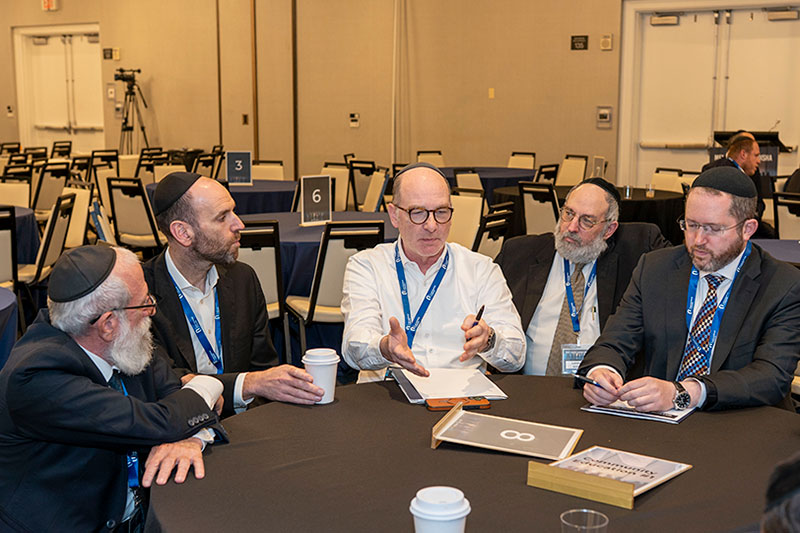
The OU Looks Forward," the organization brought together hundreds of
rabbis and lay leaders from across the country to meet for four days at
the end of December at the Rye Town Hilton, in New York's suburban
Westchester County.
Participants were warmly welcomed by a video message from President
Bush, in which he emphasized his deep respect for the religious values
of the Modern Orthodox community and for its shared goal with the
Administration of "standing by our allies in the Middle East." (Click
here to see the President's message in Windows Media.) The
Convention was further highlighted by the presence of the Chief Rabbi of
Israel, HaRav Yisrael Meir Lau, who in a major address during Shabbat
called for increased Jewish education in both Israel and the Diaspora to
preserve the Jewish people.
The Convention opened with programmatic tracks on "Community and
Synagogue," "Political Issues and Advocacy," and "Families and
Children," as well-attended sessions explored areas of OU activity and
expertise. A special closed session for young people offered insights
into community leadership opportunities by Rabbi Ephraim Buchwald, as
well as by OU president Harvey Blitz and executive vice president Rabbi
Dr. Tzvi Hersh Weinreb.
A popular Limud Torah learning track focused on the Daf Yomi Gemarot
from Tractate Sanhedrin that corresponded to the days of the Convention;
it also included a session on "Kashrut Insights." Further, the Shabbat
program featured a wide variety of shiurim by outstanding teachers of
Torah including Rabbi Hershel Schachter, Rabbi Dr. Jacob J. Schacter,
Rabbi Dr. Aaron Rakeffet and Rabbi Dr. Yitzchok Breitowitz, and a
derashah by RCA president Rabbi Herschel Billet.
Thursday's opening dinner, at which 50 OU rabbis were honored for
leading missions to Israel in the past year, was sponsored by the Israel
Ministry of Tourism and was addressed by Rami Levi, Consul in North
America of the Ministry, and by Aharon Domb, its Director-General.
“The Thursday evening plenary session detailed a whole range of issues
that the OU must confront in the years ahead,” said Stephen J. Savitsky,
who was elected Chairman of the OU Board at the Convention. “The session
was called Areas of Challenge in Setting the Orthodox National Agenda:
An Exploration of Issues of Immediate Concern to Our Community. Having
listened to and absorbed the presentations, the OU and its leadership
are prepared to provide the appropriate response to the challenges that
were set before us.”
In the session, Stephen H. Hoffman, President and CEO of the United
Jewish Communities, providing a “view from the outside,” correctly
predicted that "major new initiatives will come forth from this
meeting." In his remarks, Mr. Hoffman emphasized the unity of Klal
Yisrael and the need for the Jewish community to work together, adding,
"Mutual respect doesn't mean approval." Mr. Hoffman told his OU
audience, "We need you to emphasize Jewish values and provide moral
guidance in our community."
Providing views "from the inside," Rabbi Howard Zack of Columbus, Ohio
asked for special attention to be paid to smaller Orthodox communities,
including encouragement to young people to settle there; Shira Reifman,
NCSY Interim Director of Operations, urged increased attention to the
voice of young leadership and to "issues relevant to their lives;" Rabbi
Leonard A. Matanky of Chicago, IL, discussing "What Values Do We Hold
Dear?" expressed concern that "we have become so comfortable in our
Diaspora that we have become accepting of values contrary to ours." In
order to preserve our values, he called on the family to assume a
greater role in education, rather than ceding it entirely to the school
or yeshiva. "It takes a family (not a village) to raise a child," Rabbi
Matanky declared, adding: "The traditional Jewish family offers our
greatest hope for the future."
In his discussion of "How Much of a Priority Is Israel in Our Lives,"
Rabbi Shmuel Goldin of Englewood, NJ praised rallies on behalf of Israel
as well as the many missions OU synagogues have organized to Israel. He
also urged extra efforts to encourage aliyah to Israel. "No matter how
comfortable we are in our lives," Rabbi Goldin declared, "we should be
concerned that we are not living in Israel."
The subject of how the OU will meet the needs of the Modern Orthodox
community and its synagogues in the years ahead, in view of newly
developing issues and challenges, dominated the Convention. "The
Orthodox Union is ready to take the steps and to make the changes
necessary to lead us into an uncertain new century," declared Convention
Chair Elliot P. Gibber.
Dr. Karen Bacon, the Monique C. Katz Dean of the Stern College for Women
of Yeshiva University, reflected on the historic consequences of being
the first woman to deliver the Keynote Address at an OU Convention,
adding that "Women's voices must be listened to at all levels of the OU
to confront and attack the problems that face our community." Women must
play a particularly significant role in family issues, she said, terming
the family unit "vulnerable" because of a variety of factors. Most
notable among them, Dr. Bacon explained, is the stress on women caused
by their growing presence in the workplace while still having major
responsibility for raising their families. This stress can lead to
"overload and conflict" in women's lives.
Dr. Bacon also noted the pressures on adolescents and college students
who are "struggling" to establish a balance between their lives as
observant Jews and their interaction with the outside world-in other
words, the conflict between the ger (the stranger) and the toshav (the
inhabitant) in America, which she singled out as a challenge facing the
Modern Orthodox community as a whole.
In their response, Harvey Blitz and Rabbi Weinreb declared that the
choice of Dr. Bacon to keynote the Convention was "symbolic" of the need
of the OU to better hear the voice of women. The OU leaders have
recently undertaken a major effort to hear from their entire
constituency, traveling the country to meet with synagogue leaders. "We
want to define ourselves in terms of what you expect from us-that's the
theme of this convention," Rabbi Weinreb told the participants. "How can
we do our programming better? How do we connect to synagogues and the
community?" he asked.
In an informal presentation, the two leaders spelled out areas in which
new directions in programming are being developed for the immediate
future. They include:
- Singles programming-not only for young people,
Mr. Blitz explained, but for those who have passed through the
shidduch (or introduction) process and are still single, and for those
who become single later in life. Mr. Blitz announced that a program is
being developed to connect local shidduch committees across the
country so they can work together and increase their effectiveness.
- National Conference of Synagogue Youth (NCSY),
which Rabbi Weinreb termed the "crown jewel" of the OU, is
successfully proceeding in its mission to bring young Jews "at the
periphery of Judaism to the core of Judaism." Just a week earlier,
Rabbi Weinreb announced, more than 400 boys and girls attended the
West Coast Regional Convention of NCSY in Los Angeles. An NCSY Action
Plan is under way to continue to refine standards of training and
supervision for staff, expanding on the extensive work that has been
done over the past two years.
- The OU college program, in which a married
couple lives on campus and studies with and advises Orthodox students
on the challenges of combining their Orthodox lifestyle with life at a
secular college, is enjoying substantial popularity and will be
expanded from its present six schools, Mr. Blitz said. OU leadership
is gratified by the number of students who have availed themselves of
this program, and by the fact that it appeals to an increasing number
of non-Orthodox students as well.
- The Yachad program for the developmentally
disabled, and the Our Way program for the hard of hearing are being
expanded to sensitize "abled" people to the needs of the disabled, so
as to make them full participants in the Orthodox world. "No child can
be left behind," Rabbi Weinreb said, emphasizing the importance of the
programs.
- Kashrut, which is the OU's largest and
best-known program, is expanding its educational efforts so that the
kosher consumer will better understand how Kashrut works and thereby
better appreciate its observance.
- Parenting Conferences, which provide expert
advice on normative issues of parenting in Orthodox families, have
been enormously successful, attracting many hundreds of people to the
sessions, Rabbi Weinreb said. Conferences are being planned across the
country. In response to community requests, some will focus on single
topics such as teenagers, single parents and other issues of concern;
in a related area, curricula are also being planned to deal with
pre-marital education.
- The OU is expanding its work on domestic
violence, sexual abuse and other instances of abuse in the community;
it will partner with other concerned organizations to respond
proactively to what Rabbi Weinreb termed "this sensitive need."
- The Institute for Public Affairs (IPA) will
expand its educational efforts to inform the Orthodox community of how
IPA works on its behalf. Thanks in part to the work of IPA, President
Bush recently announced a change in federal regulations which
previously had prohibited disaster relief from going to religious
institutions; as a direct result of this change, federal assistance is
being provided to a Seattle yeshiva damaged by an earthquake. IPA, of
course, will continue its highly successful efforts in the White House
and on Capitol Hill to marshal support for Israel and for the domestic
issues that concern our community.
- Israel, as always, will remain central to the
work of the OU. The Israel Center in Jerusalem does "amazing things,"
declared Rabbi Weinreb, adding that efforts are being expanded to
assist communities affected by what he termed "terrorism and trauma."
The OU recently undertook a program to sell at $1 apiece 100,000
credit card-sized cards featuring the
MiSheberach Lema'an
Hachayal (click link for details and order form)-the prayer for
the Israel Defense Forces-with the entire proceeds being donated to
the Friends of the Israel Defense Forces to assist injured and needy
soldiers.
In addition, action plans are underway to provide
outreach to young people, with the goal of involving them in OU
leadership; and at the other end of the spectrum, a Task Force on the
Elderly is in the formation stage.
In the Convention's concluding session, the OU commemorated the 100th
birthday and tenth Yahrzeit of Rav Joseph B. Soloveitchik, zt"l, in a
standing-room only program chaired by OU honorary president Julius
Berman and addressed by some of the Rav's most illustrious students, now
leaders in the Modern Orthodox community: Rabbi Hershel Schachter, Rabbi
Dr. Jacob J. Schacter, Rabbi Kenneth Brander, Rabbi Menachem Genack,
Rabbi Dr. Aaron Rakeffet, Rabbi Fabian Schonfeld, and Dr. David Shatz.
This Convention marked the completion of Harvey Blitz's first two-year
term as president, to which he was reelected, and Rabbi Weinreb's first
year as executive vice president. Together with treasurer Herbert Seif
and a dedicated team of senior officers and executive board members,
they have made substantial progress in this time period toward setting
the Union on a firm basis of fiscal responsibility. Changes in
governance and organizational structure have been put in place, with
additional significant moves in progress. The improved atmosphere was
reflected in the upbeat mood at the Convention. "The Convention was an
overwhelming success," said Mr. Blitz. "Our large and enthusiastic
attendance from all over the country; the excellent presentations both
in plenary sessions and smaller groups; the willingness of participants
to tackle the agenda of determining future directions for the OU; the
davening and the shiurim; the presence of Chief Rabbi Lau and the
welcome from President Bush, all combined to create a spirit of
exuberance, even as we deliberated difficult topics."
Rabbi Weinreb took note of the family atmosphere. "The family is at the
heart of Orthodox Judaism," Rabbi Weinreb said. "The presence of
countless children-from babies (at least one as young as 12 weeks) to
teenagers-attending the Convention with their parents, sharing meals
with them, being blessed by them at the Shabbat table, reinforced in our
minds that what we were doing at the Convention was being done for our
children, for their future, for the future of the Jewish people."
See photo essay on the convention
www.ou.org
# # #
Comments?
Requests? Questions?
 Union of Orthodox Jewish Congregations
of America
Department of Public Relations
Stephen Steiner
Director of Public Relations Main Office:
11 Broadway, New York, NY 10004
Phone:
212.613.8318 Fax: 212-564-9058
E-mail: media@ou.org |
| OUPR
Archives
Recent
statements to the press
-
Articles and statements from
2000
-
Articles and statements from 1999
-
Articles and statements from 1998
|
|