
OUDepartment of Public Relations

March 28, 2005

A Program That Can Come to Your Community:

Experts Affirm that ‘Good Parents are Made, not Born,’ as Hundreds Attend OU’s Positive Jewish Parenting Conference in Brooklyn

Keynoter OU Executive Vice President Rabbi Dr. Tzvi Hersh Weinreb: “Parenting is a skill that can be learned. No one is born being a good parent.”

Keynoter Rabbi Dr. Abraham J. Twerski: “Our children are being raised in a world in which we were not raised.”

“Parents sat in classrooms assiduously taking notes.”

A huge gathering took place in Brooklyn, NY a week ago, but it could have been in any community, any place in which Jewish parents love their children. Many hundreds of people attended, as they always do for this type of OU event. The main message was loud and clear: good parents are made, not born, and to become a good parent – in particular an effective Jewish parent -- requires a great deal of hard work.

“Parenting is a learned skill. No one is born being a good parent,” declared Orthodox Union Executive Vice President Rabbi Dr. Tzvi Hersh Weinreb, distinguished not only as a rabbi but also as a clinical psychiatrist. Delivering one of the program’s two keynote addresses, he said, “There are people out there who have something to teach about being a parent. They are parents themselves, rabbis, psychologists and psychiatrists. No one is a perfect parent and parenting can be taught.”

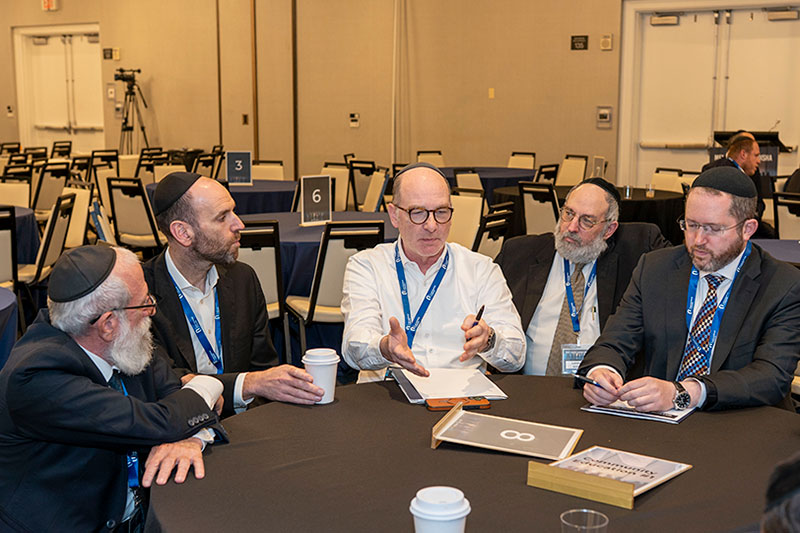
This message was delivered at the Orthodox Union’s “Positive Jewish Parenting” conference, held last Sunday at the Edward R. Murrow public high school, a facility large enough to accommodate the more than 800 people -- encompassing the entire spectrum of Orthodox life -- who attended. Not all of them came from Brooklyn; parents from as far away as Baltimore made the trip. Mothers outnumbered fathers by a substantial number in attendance. Some parents brought babies in carriages and strollers, either to begin preparing for the challenging years ahead, or to learn how to deal with their older children at home. Grandparents came as well, eager to impart knowledge to their adult children.

That knowledge, absorbed by all who attended, served to strengthen the community. “The purpose of the conference was to empower the community and to give it direction in relating to its children,” declared Rabbi Moshe D. Krupka, OU Executive Director for Programming, who coordinates the OU’s wide variety of approaches to bettering Jewish life. Strengthening Jewish families has been a key OU focus for several years. Now, it has been joined by three emerging task forces, “Safe Homes, Safe Shuls, Safe Schools,” to confront a variety of harmful behaviors emerging in the community.

“This Positive Parenting conference was in a real sense a kickoff of the ‘Safe Homes’ Task Force, Rabbi Krupka said.

The OU has presented its “Positive Jewish Parenting” events for several years around the country and in the New York area as well, always with large audiences. This was the first event in Brooklyn, however, and the community came out in force.

“Thank you! Thank you! Thank you!” wrote one participant on her evaluation form. “I was always envious of other communities that had this program. Thanks for coming to Brooklyn.”

Co-sponsors of the conference included the FEGS health and human services system; the Board of Jewish Education of Greater New York; MASK International; and the office of Brooklyn Assemblyman Dov Hikind.

The OU and FEGS have developed a substantial partnership over the past few years. They are also combining efforts on the ParnossahWorks program, in which OU synagogues in the New York tri-state area and FEGS’ expertise in the job market join together to help the unemployed and underemployed find meaningful work. Several dozen people have already been placed through the program. As an adjunct to ParnossahWorks, the two organizations, together with a third partner, the JBFCS family service agency, will present three two-hour employment workshops at OU headquarters on April 5, 12 and 19.

The Brooklyn parenting conference dealt with young children up to teenagers. The parents sat in classrooms assiduously taking notes. They asked questions, referred to personal experiences, and in many cases shared their concern – even their anguish – about their problems. “My 17-year-old daughter unfortunately passed her driver’s test,” one mother said. “We let her have the car for the first time last night and she didn’t come home until 2:33 this morning. I told her she’s under a curfew from now on. She said to me, ‘You’re so neurotic. Nobody else has a curfew.’ ”

As Rabbi Weinreb said, it’s not easy being a parent.

Pervading the entire program was a sense that the intrusion of the modern world and its pathologies has seriously complicated the job of raising a Jewish child. In session after session, the experts – those various parenting resources referred to by Rabbi Weinreb -- singled out cell phones, even more perhaps than the Internet, as a cause for alarm. “Now kids have cell phones. We don’t know who’s in their lives,” declared Rachel Pill, CSW, in a session on “Teenagers…When the Hormones Kick In.”

The theme of modernity was the essence of the second keynote address, by the Hasidic Rav and psychiatrist, Rabbi Dr. Abraham J. Twerski, the Founder and Medical Director Emeritus of Gateway Rehabilitation Center near Pittsburgh.  The Jews are a people of mesorah – tradition – Rabbi Twerski said, and there is a time when we follow tradition. There are times, however, when we have to be original; such a time is now. “Things have changed,” he declared.  “It’s not the same world.”

“We have gone through a moral mabul (using the Hebrew word for Noah’s flood, or deluge) in which ethics and morality have been thoroughly eroded. Our children are being raised in a world in which we were not raised. The world deteriorates morally day to day.”

“For 20 years I have been saying our children are at risk,” Rabbi Twerski declared. “They live in a world awash in corruption, drugs and alcohol. They are looking for shalva (the quality of inner peace). But life is a struggle. Life is not supposed to be easy.”

By struggling to do right by our children, Rabbi Twerski declared, we find new ways to propagate the mesorah, the tradition, by dealing with life the way it is lived today and adjusting our responses accordingly. (For Rabbi Twerski’s guidance on how to achieve Shalom Bayit, Harmony in the Home, see sidebar.)

In his keynote address, the OU’s Rabbi Weinreb defined both parenting and its specific component, Jewish parenting. He defined parenting as “a goal-oriented teaching process,” with “goal-oriented” referring to planning ahead and working to achieve an objective, what he termed “the essence of intelligent behavior.”

“A parent must have in his or her mind the kind of child that parent wants to produce. Parents work together toward teaching their child, he said, with teaching being a process that takes many years. The goal for most Jewish parents is not to raise a “superstar – it’s hard to be a superstar and it’s hard to raise a superstar,” but rather to raise a “mensch,” a good person.

“How do I raise a child who’s a Kiddush Hashem (Sanctification of the Divine Name) so that in later years people will say to that now-grown child – ‘Wow, what great parents and teachers you must have had!’ This requires teaching. Teaching is not lecturing; it is leading by example, serving as a role model. Children learn by who you the parent are and how you act.”

Noting that parenting is a lifelong process, Rabbi Weinreb, whose address was interspersed with many tender and warm reminiscences from his own life, declared, “If you don’t believe me, ask my mother.” He is a parent and grandparent, and even has married grandchildren, but he is still his mother’s child, and she looks out for his well-being.

Certainly there are problems in raising a child, but Rabbi Weinreb advised, “If you hang in long enough, you will see nachas (satisfaction) you never expected to see.

Rabbi Weinreb, speaking as a clinical psychologist, then explained specifically Jewish parenting. “In psychological terms,” he asked, “what makes Jewish parenting Jewish?” He gave four criteria (see sidebar).

“Our two extraordinary keynoters sent out the message that Jewish parenting is a very special skill, but a skill that is continually being revised,” declared Emanuel J. Adler, Chair of the OU Community and Synagogue Services Commission.  “Each workshop session at the conference applied new lessons to lessons from of the past to assist Jewish parents in doing the job right.”

These workshops, explained Frank Buchweitz, OU Director of Special Projects who coordinated the massive event, included “literally any topic you can think of in raising a Jewish child in this day and age.” He cited relatively new concerns such as incidents of drug and alcohol abuse in the Orthodox community, which was discussed in two workshops, along with longtime issues of parental concern.

These issues include sibling rivalry; religious differences between parents and their children; responding to anger in your teenager; developing a positive relationship with your teenager; coping with peer pressure; when to get help for your teen; when teenagers’ hormones kick in; how to help your busy children manage their time; how to get your teenager to listen; developing positive self-esteem; and preventing eating disorders.

“If it affects the behavior of your child, we covered it in the conference,” Mr. Buchweitz said.

Parents were most appreciative. Some typical comments from the evaluations filled out immediately following the conference include:

“It was reassuring to hear that we are all struggling with the same issues in dealing with our children. It was also important to hear the unique nature of Jewish parenting from Rabbi Weinreb. This conference was fabulous. We need more of them. Effective parenting can surely reduce at-risk behavior.”

Wrote another parent, “I feel inspired and enlightened to be a better parent, role model and partner in raising my children.”

“It was all amazing and helpful,” wrote a parent. The presenters “really understood what we are going through,” declared another.  Said a third, “You had up-to-date and ‘in-the-know’ people speaking in the workshops. It was so great.”            

Tapes of conference sessions are available. They may be purchased for $6 apiece from the OU website, www.ou.org, or by calling 212-613-8290.

To discuss bringing the OU’s “Positive Jewish Parenting” conference to your community,” contact Mr. Buchweitz at frank@ou.org, or 212-613-8188.


Sidebars:

HOW TO RAISE A JEWISH CHILD: TIPS FROM THE EXPERTS

Sidebar A-Rabbi Tzvi Hersh Weinreb’s Four Criteria

For Raising a Jewish Child:

·    Teaching a sense of self. “A Jewish parent must teach a sense of self – who that child is,” Rabbi Weinreb explained. “One way is the name we give to our children. Their names begin to shape who that child is.”  Naming a child after a grandparent, for example, says that the parents expect their child to carry that grandparent’s name with honor.

·    Teaching a sense of family. “Your child is not alone, but is part of a family, one’s own family, and the mishpacha (family) of the entire Jewish people,” Rabbi Weinreb said. “The child is safe in the family; your family is your sanctuary forever.”

·    Teaching a sense of Jewish identity. “You are part of the Jewish people, part of Am Yisrael.” Every Jew, therefore, is linked together.

·    Teaching a sense of spirituality, which he defined as, “what it means to have a personal God to talk to at any time, a special relationship with the Ribbono Shel Olam,” the Master of the Universe.

To the extent we teach our children in this manner, Rabbi Weinreb said, “God will give us Divine assistance” to produce a well-raised child.”

Sidebar B-Rabbi Abraham Twerski’s Advice on How to Achieve Shalom Bayit (Harmony in the Home):

·    Calling for Shalom Bayit, harmony in the home, Rabbi Twerski advised not to look for shalva (inner peace), which may be unattainable, but for simcha (joy). Simcha, he said, is the feeling of fulfilling our obligations, struggling against the yetzer hara (the evil inclination), and avoiding lashon hara (gossip and tale bearing). Families should eat together as much as possible, he urged, explaining that studies prove that families that eat together, stay together.

·    Don’t look out only for yourself, Rabbi Twerski urged, but for your entire family. For parents, this may mean drinking less so as not to influence their children.  Parents must set a good example through their behavior and so may have to do without some things they want in order to be a good influence.

·    Humans have a special capacity, he said. “Human beings are the highest form of life. We have a goal in life. We have a purpose in life. Humans are the only creatures who can give up something for themselves for the betterment of someone else. Shalom Bayit is the greatest gift we can give to our children.”

Sidebar C-Gems from the Workshops:

The 14 workshops at the OU’s “Positive Jewish Parenting” conference produced volumes of information for Jewish parents on how to bring up their children. A compendium of good advice follows:

·    “Is My Teen Just Being a Teen? Or, Help! Do I Need Somebody,” with David Pelcovitz, Ph.D. – If siblings are fighting and bickering, you must tell them, “This behavior is unacceptable in this house.”

·    “Responding to Anger in Your Teenager,” with Susan Buchweitz, LMSW -- Empathy goes along with trust and respect; showing empathy is a way of opening the door of communications.

·    “Signs and Symptoms: Identifying Different Drugs and Their Effects on the Individual,” with Joshua Lamm, MD – “We’ve caught up with the outside world; it’s time to put a stop to it.”

·    Teenagers…When the Hormones Kick In,” with Rachel Pill, CSW – “If kids carry around cell phones you’re looking for trouble. The Internet is dangerous. I’d abolish it if I could. If you have it, it should be in a public space.”

·    “Helping Our Children Develop and Maintain Positive Self-Esteem,” with Aviva Biberfeld, Ph.D. – “Self-esteem in our children is related to self-esteem in ourselves.”

·    “Getting Your Adolescent to Listen: Practical and Effective Techniques for Managing Your Teenager,” with D. Alex Bailey, Psy.D.—With adolescents, “You just can’t throw down a rule and expect it to be obeyed (as they did when they were younger). You must dialogue with your teen.”

·    “Adolescent Alcohol and Drugs: Why It Starts, How to Spot It, Stop It, and Get Help,” with Lewis J. Abrams, LCSW—More than 80 percent of teens with substance abuse problems “had their first taste of the substance at a Jewish function.”

·    “Tips for Preventing Eating Disorders in a Weight-Conscious Society,” with Shayna Oppen, LMSW – “Restricting food inevitably results in over-compensation.”

* * *

The Orthodox Union, now in its second century of service to the Jewish community of North America and beyond, is a world leader in community and synagogue services, adult education, youth work through NCSY, political action through the IPA, and advocacy for persons with disabilities through Yachad and Our Way. Its kosher supervision label, the , is the world’s most recognized kosher symbol and can be found on over 275,000 products manufactured in 68 countries around the globe.

www.ou.org

Comments? Requests? Questions?

OU Statement to The Press - From the OU Department of Public Relations

Orthodox Union
Department of Communications and Marketing

David Olivestone
Director

Stephen Steiner
Director of Public Relations

Main Office:
11 Broadway, New York, NY 10004
Phone:
212.613.8318 Fax: 212-613-0763
E-mail: steiners@ou.org   media@ou.org

OUPR Archives

Recent statements to the press:

2003  |  2002  |  2001  |  2000  |  1999  |  1998